News (All)

CMM Relocates Offices to Accommodate its Growth

Posted: October 29th, 2013

Campolo, Middleton & McCormick is celebrating its 5th anniversary by tripling the size of its office space. The expansion will assist in the firm’s strategic growth plans while improving daily operations to provide outstanding service that their clients have grown to expect. Now located on the fourth floor of 4175 Veterans Memorial Highway in Ronkonkoma, at the entrance to MacArthur Airport, the new space offers state of the art technology, more offices, a more efficient layout and larger event rooms.

Since its inception, Campolo, Middleton has grown to a full service practice now with 17 attorneys. Campolo, Middleton’s growth derives from its philosophy of delivering Big Firm Quality and Small Firm Value. The firm has carved out a reputation of delivering the highest quality of services and the most efficient and cost-effective solutions.

In announcing the move, Managing Partner Joe Campolo said, “We’re excited to expand our office and our practice in a location perfectly suited to serve the needs of our clients and the firm. Ronkonkoma is an ideal location in terms of its size, close proximity to the airport, the LIRR and its easy access to the major highways. The redevelopment of the area, known as the Ronkonkoma Hub project, will revitalize the community and the firm is excited to be a part of that economic growth for the region.”

Supreme Court Sharpens Focus on Arbitration and Class Actions

Posted: October 28th, 2013

This blog previously explored the Supreme Court’s June 2013 decision in American Express Co. v. Italian Colors Restaurant, in which the Court validated the credit card company’s contract with merchants mandating arbitration and eliminating the possibility of a class action (a result Justice Elena Kagan memorably described as “Too darn bad”).

Shortly before deciding the apparently contentious Italian Colors case, however, the Supreme Court unanimously decided Oxford Health Plans LLC v. Sutter. The facts leading up to this case began over a decade ago, when physician Ivan Sutter and Oxford Health Plans entered into an agreement whereby Oxford would pay Dr. Sutter for the medical services he provided to Oxford members. The agreement contained an arbitration clause prohibiting litigation of disputes in court, instead mandating arbitration.

Several years into the agreement, Dr. Sutter filed a class action on behalf of himself and other physicians in Oxford’s network, claiming that Oxford had failed to promptly and fully pay the doctors for their services. Oxford moved to compel arbitration, which request was granted by the New Jersey Superior Court. The parties then agreed that the arbitrator should decide whether their agreement authorized class arbitration.

During the course of the arbitration proceedings, the Supreme Court decided Stolt-Nielsen S.A. v. AnimalFeeds International Corp., 559 U.S. 662 (2010), holding that the Federal Arbitration Act (“FAA”) prohibits class arbitration absent contractual evidence that the parties had agreed to allow it. Meanwhile, in Sutter, the arbitrator found that the contract between Oxford and Sutter did allow for class arbitration.

Oxford then moved to vacate the arbitration award in federal court, arguing that the arbitrator had exceeded his powers under the FAA. The District Court denied the motion, and the Third Circuit affirmed, upholding the arbitrator’s decision to allow Sutter’s claim to proceed in class arbitration. The case then made its way to the Supreme Court, which unanimously affirmed, holding that the arbitrator had not exceeded the scope of his power. In fact, the arbitrator had done precisely what the parties had requested: interpret the agreement and decide whether it permitted class arbitration.

Under FAA § 10(a)(4), a Court can vacate an arbitration award only “Where the arbitrators exceeded their powers, or so imperfectly executed them that a mutual, final, and definite award upon the subject matter submitted was not made.” As the arbitrator did not exceed or “imperfectly execute” his powers in this case, the Supreme Court, given the limited scope of review, confirmed that the arbitrator’s decision could not be overturned-even if they thought it was wrong. (Although Oxford had relied on the Court’s decision in Stolt-Nielsen in its efforts to overturn the award, the Court rejected Oxford’s arguments, pointing out that in that case the parties had stipulated that they had never reached an agreement regarding class arbitration.) As Justice Kagan summarized: “The arbitrator’s construction holds, however good, bad, or ugly.”

The Sutter decision is a reminder that arbitration, while often considered an appealing and less expensive alternative than litigation, is not without risk. Businesses should take care to ensure their agreements set forth their arbitration procedures with specificity.

Should You Talk to Your Heirs?

Posted: October 26th, 2013

By: Martin Glass, Esq. email

Tags: ,

Last month I discussed how to avoid a Will contest. I noted that one way to at least minimize that risk is to talk to your heirs about your estate plan. It sounds simple, but the subject of inheritance is one that most people arduously avoid for a number of different reasons: superstition, fear, lack of knowledge, or a misguided desire for secrecy. Many adults, such as my parents, were raised to believe that money was a private affair, and that talking about it was inappropriate. But beyond that, many people simply fear that if they talk about their estate plan with their heirs, they will meet with resistance, disagreement or, in a worst-case scenario, their heirs will try to counter the estate plan with legal action of their own. If that scenario exists, then a revocable trust should probably be part of your plan. But that’s a topic for another time.

While in some families and circumstances these fears are justified, in most circumstances being silent about your estate plan can have more disastrous consequences. If nothing else, a refusal to talk about money or your estate plans with your children means that they will have a difficult time following your wishes in regards to your medical treatment or protection of your assets should disaster strike. Most adult children are actually eager to fulfill their parents’ last wishes, regardless of how it may or may not impact their own inheritance, especially if they understand why their parents are doing what they’re doing.

Furthermore, your plans for leaving a legacy for your children or grandchildren may clash with their own needs or plans. For example, you may want to leave extra money to a grandchild with special needs, but if that child is receiving government benefits, leaving a significant inheritance in their own name could cause a loss of those benefits. Or one child may be doing very well and has no need to add to their estate. They may, in fact, prefer if you gave their share to their siblings. Discussing your plans with your children ahead of time can prevent situations like these from occurring.

So the answer to the question above is yes — you should talk to your children or heirs about your estate plan. Talking about it will not only make it easier for them to follow your wishes, but it may even help you determine how you want to make the best difference in their lives

The information contained in this article is provided for informational purposes only and is not and should not be construed as legal advice on any subject matter. The firm provides legal advice and other services only to persons or entities with which it has established an attorney-client relationship.

5 Hard-nosed Negotiation Tips from Steve Jobs

Posted: October 25th, 2013

By: Joe Campolo, Esq. email

Tags:

A judge ruled last month that Apple violated antitrust laws in conspiring with some of the largest book publishers to fix e-book prices. While Apple continues to fight the allegations, there is a lot to be learned from the released e-mail exchange between Steve Jobs and James Murdoch. The e-mails had an important role in the lawsuit, but they also provide an savvy high-stakes negotiation between the leaders of two powerful firms.

Eric Sherman writer for Inc.com, reviews the series of e-mails and the negotiation principles used to create the best conditions for winning.

“A series of emails about ebook prices between Apple and HarperCollins, including ones written by Steve Jobs, were recently released as part of the Department of Justice price-fixing suit against Apple and a number of major publishers. As the site Quartz pointed out, these offer some great insight into how Jobs negotiated.

However, Zachary Seward at Quartz called it an example of “hard-nosed” negotiation at which Jobs excelled. I’d take a different view. This is not hard-nosed. The emails show how an excellent negotiator used a series of principles to create the best conditions for winning. Let’s look in greater detail at the exchange between Steve Jobs and James Murdoch, son of Rupert Murdoch and the ultimate decision maker, and see how Jobs ultimately got his way.”

To read the full article, click here.

The Common-Interest Doctrine and Its Effect on Attorney-Client Privileged Communications

Posted: October 9th, 2013

It is widely understood that communications between an attorney and his/her client are protected from disclosure under the attorney-client privilege. It should be equally understood that the attorney-client privilege is lost or waived if a third party is present for those communications. However, there is an exception to the latter rule: the common-interest doctrine.
The common-interest doctrine holds that a third party may be privy to an attorney-client privileged communication, and the privilege will stay intact, if the communication is made for the purpose of furthering a nearly identical legal interest shared by the client and the third party. Hyatt v. State Franchise Tax Bd., 105 A.D.3d 186, 205 (2d Dep’t 2013). Courts have interpreted the “furthering a nearly identical legal interest” portion of the doctrine to require that the communication be made in pending litigation or in reasonable anticipation of litigation where the client and third party have a common legal interest. Id., Aetna Cas. And Sur. Co. c. Certain Underwriters at Lloyd’s London, 176 Misc.2d 605 (N.Y. Sup. 1998), aff’d, 263 A.D.3d 367 (1stDep’t 1999).

In a recent decision dated October 16, 2013 from the New York County Supreme Court, the Court refused to expand the reach of the common interest doctrine to communications between two parties involved in a merger and one of the parties’ counsel. In Ambac Assur. Corp. v. Countrywide Home Loans, Inc., 2013 NY Slip Op 51673(U), the Court reviewed the determination of a Special Referee following a discovery dispute who decided not to extend attorney-client privilege protection over communications related to a merger between Countrywide Home Loans, Inc. (“Countrywide”), its counsel, and co-defendant Bank of America Corp. (“BOA”). Counsel for BOA sought to have the Special Referee’s determination vacated arguing that the common-interest doctrine should apply to the communications between Countrywide, BOA, and counsel.

However, the Court in Ambac, citing to Hyatt and various other cases applying New York law, held that the common-interest doctrine extends only to situations where there is, at minimum, a reasonable anticipation of litigation. While the Court observed that the common-interest doctrine would also apply to a situation where there was dual representation– i.e. if Countrywide and BOA were represented by the same counsel – this was not the situation here. In addition, although the Court did note that at least one federal court elsewhere in the country had found that communications made after a merger agreement was signed did fall within the common-interest doctrine, no New York cases had expanded the doctrine to that extent.

Based on this decision, it would certainly be wise for attorneys and clients alike to take extra caution when communicating to make sure that the all-important attorney-client privilege remains in place.

Special Note for Commercial Litigators

The New York State Courts website now allows you to specifically search for decisions from the Commercial Division, whether in an appellate court or one of the lower courts. If you want to search the Commercial Division decision database, simply go to http://iapps.courts.state.ny.us/lawReporting/Search. Once on the site, select Commercial Division at the bottom of the drop down list that appears in the “Search by Court” field of the Advanced Search form. From there, you can type search terms into the “Search Full Text” field (at the bottom of the Advanced Search form) and hit Enter or click Find. This database is a great way to stay on top of recent case law affecting commercial litigators.

LIPA Must Come Clean About Its Time-of-Use Residential Billing Rates So Consumers Can Make an Informed Decision Whether to Return to Standard Rates

Posted: October 8th, 2013

In an earlier blog, published on September 26, 2013 (LIPA Residential Time-of-Use Customers Beware – Your Efforts to Shift Usage to Off – Peak Hours Is Probably Costing You Money Compared to Regular Residential Rate Payers Who Are Billed the Same Rate Regardless of Time-of-Use”), we urged LIPA residential rate payers who switched from standard 180 rates to one of two principal LIPA time-of-use billing programs to take a hard look at their bills because they likely were spending more, not less, for electricity.  The 184 time-of-use billing program is for consumers who expect to use 39,000 kWhs a year or more than 12,600 kWhs during the summer months (June – September), and believe they can shift some of their usage from peak hours (10 AM – 8 PM) to off-peak hours (8 PM – 10 AM and weekends).  The 188 program is for consumers who do not meet the criteria for 184 billing, but believe they can shift usage to off-peak hours.  I analyzed a full year of my LIPA bills, determined that 67% of my usage was during off-peak hours, and yet I paid more under the 184 program than I would have had I never switched from standard 180 billing.  I ran my actual usage through the 184 and 188 rates, and then assumed that my usage was much higher (39,000 kWhs per year rather than 23,000) and determined that I would have saved money under any reasonable scenario had I never switched from standard billing rates.

Why did I pay more each month despite shifting so much of our electrical usage to off-peak hours (e.g., by only washing and drying clothes and washing dishes at night and on weekends)?  In the case of 184 billing, it turns out, LIPA imposes a daily “Service Charge” of $1.65 per day, regardless of how much electricity is consumed, compared to only $0.36 per day for standard 180 rate payers.  Thus, 184 rate payers pay LIPA approximately $470 a year more for the Service Charge. The only way they can save money by being in the 184 rate category is if the charges for electricity more than off-set the excess Service Charge.  While the electrical rates, which are designed to encourage shifting of usage to off-peak hours by charging much more for usage during peak hours (particularly during summer months) than during off-peak hours, in fact resulted in my paying $245 less for the year than I would have been billed as a standard rate payer, my total charges for the year were $225 higher under the 184 rate because of the much higher Service Charge.  Despite the fact that 67% of my electrical usage was during off-peak hours, I could not off-set the huge Service Charge differential.

188 rate payers, whose usage does not qualify them for 184 billing, pay the same $0.36 per day Service Charge that standard 180 rate payers must pay.  However, LIPA added a $0.10 a day meter charge to 188 rate payers’ bills.  No meter charge is imposed on 184 or 180 rate payers.  In addition, 188 rate payers pay more for electricity during peak summer month hours than either 180 or 184 rate payers.  After the first 250 kWhs during summer months, standard 180 rate payers are charged $.0975 per kWh (regardless of the time of day); 184 rate payers are charged $0.2364 per kWh during peak hours, and 188 rate payers are charged $0.2735 a kWh for every kWh used during summer peak hours.

I performed this analysis because I needed to determine whether it made financial sense for me to stay on 184 billing after a Solar Photovoltaic system installed on the roof of my home went active on August 21st, a system large enough to cover all or most of the electrical needs of my family (I am happy to report that the first bill I received for the first 26 days was for a little more than $10, compared to around $550 for the same period the year before).   When I asked LIPA if it would run my usage through the 180 and 184 billing to see which one was better for me based on my actual usage, I was told that LIPA could not do so.  Putting the question to Mike Bailis of Sunation, the company that installed our Solar Photovoltaic system, Mike informed me of the huge Service Charge I had been paying compared to most ratepayers who were not shifting electrical usage to off-peak hours.  I then took the time to do the analysis myself, and learned for the first time that, rather than save money by shifting so much of our usage to off-peak hours, it was costing me more than $200 a year because of differences between the Service Charge imposed on 184 ratepayers compared to standard 180 customers.

It was then that I realized for the first time that there might be thousands of rate payers, like myself, who shifted to residential time-of-use billing because they mistakenly believed they would save money, while helping LIPA by reducing consumption during peak hours over the summer.  I repeatedly brought my analysis to the attention of LIPA’s COO, CFO, and Director of Regulatory, Rates and Pricing, urging them to go to the LIPA Trustees and change the 184 and 188 rate schedules so they would provide an actual benefit, instead of a penalty, for those who shifted electrical usage from peak to off-peak hours.  The only response I received was a letter suggesting that my unusually low usage during non-summer months may be the problem, but that did not mean others did not benefit from the time-of-use rates.

On October 4, 2013, Claude Solnik, writing in the Long Island Business News (“LIPA Tinkering With Fluctuating Rate System”), described a five year experiment adopted by LIPA in May, 2013 (please see our  previous Blog which describes this program).  The five year experiment LIPA is undertaking for a limited number of customers reduces peak hours from 10 to 5, and increases peak billing rates from the 188 rate of $0.2735 per kWh to more than 40 cents a kWh.  The article then states:  “LIPA board member Matthew Cordaro said the point of the program is to save money for customers, while Little said that having fewer peak hours has become an industrial trend.”  The reference is to John little, LIPA’s Director of Regulatory, Rates and Pricing, and to LIPA Trustee Matthew Cordaro, a Senior Vice President with LILCO when he resigned after 22 years with the company).

In the article, Mr. Solnik briefly mentioned my concern that there may be numerous rate payers who shifted to time-of-use billing in the belief they were saving money, without ever being told that they would be billed so much more than standard rate payers for daily rates, or that, as a result, they likely were spending more, despite shifting use to off-peak hours.

If LIPA wants customers to save money, instead of putting off the problems created for current residential time-of-use customers for five years, it should change those rate schedules now so that they provide an incentive – not disincentive – for customers to shift usage to off-peak hours.  In fact, it is questionable whether saving its customers money is LIPA’s goal.  In a report presented to the Trustees on May 23, 2013, available on LIPA’s website, the following statement is found:  “In addition to creating a greater incentive for participants to reduce their energy consumption during the more expensive peak hours, the proposed higher energy charge will make the experimental rate more revenue neutral with LIPA’s standard non-time-differentiated residential rate.”

John Little’s statement in the LIBN article that “having fewer peak hours has become an industrial trend” makes it seem that this has occurred without any incentives being provided by the industry.  LIPA’s purported need for time-of-use billing to be “revenue neutral” appears to be the reason that time-of-use rate payers  are charged so much more for daily Service Charges and are charged ever- higher peak rates.  Thus what LIPA is saying is that, while its charges for electrical usage might save time-of-use ratepayers money, LIPA must take those savings back through other charges.  This most definitely is not the right approach to getting rate payers to shift usage to off-peak hours.

The Public Service Commission requires utilities to have available during peak hours sufficient electricity to meet more than anticipated peak loads.  While it is my personal belief that it is in everyone’s interest to shift their usage to off-peak times, because doing so will help reduce the number of new power sources LIPA must induce to be built with promises of long term power purchase agreements, it is doubtful that this is sufficient incentive to get ratepayers to shift usage.   While doing laundry and washing dishes at night and weekends has become second nature to my family after twenty years, there is no question that it would be more convenient to launder clothes or wash dishes any time we want.  If LIPA wants to persuade the public to shift usage to off-peak hours, it must provide a financial incentive for the public to do so.  The fewer power sources that must be constructed, the better it is for all rate payers who ultimately pay for those new sources.

The LIBN article indicates that there are approximately 12,000 residential rate payers in one of the time-of-use billing programs, a small percentage of LIPA’s one million customers.  In my last Blog, I suggested that LIPA eliminate 188 time-of-use rates, along with its $0.10 per day charge for the meter (a charge not imposed on 180 or 184 ratepayers), and make the Service Charge billed 184 ratepayers the same as everyone else is charged – $0.36 per day rather than $1.65.  Under such a rate schedule, I would have saved $245 compared to what I would have been billed under 180, instead of paying $225 more to LIPA.  LIPA estimated in 2008 that the average residential home on Long Island uses 9,548 kWhs a year, an increase of 1,811 kWhs since 1997.  (See “Long Island Power Authority Summary:  Recent Trends In Residential Electrical Use.”).  Projecting this increase forward, the average residential home on Long Island today should consume about 10,290 kWhs per year.  Thus, the average residential ratepayer on Long Island consumes about 43.4% of the electricity that my family consumed.  If I would have saved $245 under the amended 184 rate schedule I proposed, the average rate payer, whose off-peak usage equaled 67% of total usage (as was the case with my family’s usage), would be expected to save $106 a year.  Multiplying that by the 12,000 time-of-use customers, LIPA would receive $1,272,000 less than it would have had these ratepayers been in the 180 standard rate category.  Since all rate payers benefit from the reduced capacity LIPA must have on hand during peak hours, because their rates will go up less quickly, those ratepayers who decline to participate in time-of-use billing programs could be billed approximately $1.27 a year to cover the lost revenue from the incentives offered to time-of-use ratepayers, a rather insubstantial amount.

Next in the LIBN article, we are told that “Little said LIPA suggests customers ask for rate comparisons, including meter costs, before signing up. In most cases, the time of use plan works out for the customer, Cordaro said.”

Considering LIPA’s rejection of my express request for a rate comparison, I question whether Mr. Little is correct.  Further, it is difficult to see how LIPA could do the comparison which it purportedly recommends.  People on the 180 billing rate schedule (the standard rate) receive a bill that tells them their total kWhs consumed during the billing period.  Without a different meter installed for time-of-use customers, how will LIPA know what percentage of the customer’s usage is during peak hours and what percentage is during off-peak?  Without that knowledge, it is not possible to compare what a 180 ratepayer would have been billed had 184 or 188 rates been applied.

As for Mr. Cordaro’s assertion that, “In most cases, the time of use plan works out for the customer,” I do not believe he has any basis for his statement.

My son assisted me by creating an Excel program that permits existing 184 and 188 time-of-use LIPA customers to input their actual annual usage, and learn what they would have been billed under 180, 184, and 188 rates.  Anyone interested in performing such analysis to determine if they should switch back to standard 180 rates can find this program on my website (www.LI-EnviroLaw.com) along with instructions for its use.

The beauty of the program created by my son is that, once actual kWhs for the year are known, and the percentage of total kWhs that are used during summer and non-summer months, and the percentages of peak versus off-peak usage during summer months and non-summer months are determined, the total cost of 180, 184 and 188 billing is automatically calculated (just electrical charges, Service Charges, and, for 188 customers, meter charges, are calculated because every other charge on the LIPA bill is the same for everyone, so cannot effect the bottom line as to which billing rate will be best for a customer based on actual usage).

To examine whether Mr. Cordero’s assertion that most customers benefit from time-of-use plans is correct, I ran a number of different scenarios through the program.  First, I determined whether my actual usage (23,712 kWhs for the year; 47% during non-summer months and 53% during summer months; 71% off-peak during non-summer months and 63% off-peak during summer months) which resulted in my paying higher sums to LIPA whether billed under 184 or 188 when compared to 180 rates, would create savings if the same percentages were applied to lower or higher annual usage.  Starting with a presumed annual consumption of 10,290 kWhs, the approximate average residential usage on Long Island in 2013, right up to 50,000 kWhs per year, the conclusion was the same:  ratepayers pay less if they are in the standard 180 rate rather than 184 or 188.  Finally, at 60,000 kWh per year, the 184 ratepayer would save money when compared to the 180 ratepayer:  $4.00!  If the average home on Long Island consumes 10,290 kWhs a year, how many homes can there possibly be that consume 60,000 kWhs a year?  Whatever the answer, and I suspect it is close to zero, the conclusion does not support Mr. Cordero’s claim that “In most cases, the time of use plan works out for the customer”.

Keeping in mind that Mr. Little had suggested to me that the 184 rates might not have worked for me because my family consumed such an unusually low amount of power during non-summer months (11,145 kWhs for the months of October through May; 12,567 kWhs for the summer months of June – September), I ran a different assumption through the program.  I assumed that usage was flat throughout the year such that each month, the same amount of energy is consumed.  This assumption would cause 67% of usage to occur during non-summer months, rather than the 47% my family’s bills showed to be the case.  Based on this assumption, everything from the average 2013 residential usage of 10,290 kWhs, up to 20,000 kWhs per year, led to the same conclusion:  180 rates produced lower bills than would 184 or 188 rates.  However, at the actual usage my family had, 23,712 kWhs, 188 billing created a savings when compared to 180 rates:  we would have saved ten cents ($0.10)!  At 30,000 kWhs, both 184 rates and 188 rates produced a savings compared to standard 180 rates ($66 cheaper for 184; $9 for 188).  That said, keep in mind that these results occur only if usage each month throughout the year is the same.  It is difficult to imagine how anyone with air conditioning in the summer and, perhaps, a pool pump, could ever have flat usage each month.  If the point at which there is any savings at all is at roughly 23,000 kWhs a year, it is reasonable to assume that anyone consuming that much energy (which is more than twice what the average residential home uses) has air conditioners in use during the summer months.  The  amount the average home uses does not produce a savings for those in the time-of-use billing category, so how many people exist that use 23,000 kWhs a year andconsume the same amount of electricity each year?  Whatever the answer, it provides no support for Mr. Cordero’s assertion as to the benefits of time-of-use billing plans.

CONCLUSION

The final quote from LIPA Trustee Cordero in the LIBN October 4th article is as follows:  “’The bottom line should be less,’ Cordero said.  ‘If not, you should get off those rates.’”

What Mr. Cordero and others at LIPA ignore is that the typical LIPA customer does not have the time to summarize a year’s worth of bills and to run them through a program like the one on my website (and how many would even be aware that a Rate Calculator exists on my website, or, for that matter, that I have a website).  How are these customers to know if they are paying more, rather than less, by reason of being on a time-of-use plan?

How 12,000 LIPA customers came to switch from 180 billing to 184 or 188 is not known.  It seems likely that they were not told that higher daily Service Charges or higher peak hour billing would lead to their paying more for their electricity, regardless of how much usage they could switch to off-peak hours. I have been asking numerous people if they are aware they are charged a daily Service Charge regardless of use.  Most of those I have spoken with are not aware that they pay a fixed daily charge, regardless of use, even though the bill is on their bills, and none could believe that every customer is not charged the same Service Charge.  LIPA’s bills merely list the Service Charge for that customer, so the bill provides no hint that others pay a different Service Charge.

If LIPA has the means of running its 12,000 customers through a program like the one on my website, which compares actual costs based on each 184 and 188 customer’s actual usage under 180, 184 and 188 billing, it should do so.  The results should be sent to each time-of-use customer so each can make an informed decision whether to stay on time-of-use billing or switch back to standard flat billing rates.  There is no question that LIPA and its consumers benefit when consumers shift usage to off-peak times.  However, without a financial incentive to change long held habits, it is not likely that many will alter their conduct.  As soon as possible, the LIPA Trustees should change the time-of-use rates, so those who shift usage to off-peak hours are rewarded with lower bills, and those who do not, will see their bills go up.  The proposal set out above and in my last Blog should accomplish this.  If neutral net revenue is necessary, the 180 rates should be adjusted so that those not participating in time-of-use plans will make up the difference.  This should not cause 180 ratepayer bills to go up by much more than $1.00 a year.

If LIPA does not act quickly to notify existing customers in time-of-use plans whether they are in fact saving or losing money by reason of their switching from the standard 180 rate plan, or, at least, does not change the 184 and 188 rates so that those shifting usage to off-peak hours will not pay more than those in the 180 standard rate plans, the Attorney General should be asked to intervene in support of LIPA’s rate payers.


LIPA Residential Time-of-Use Rates Are Unfair

Posted: September 26th, 2013

LIPA Residential Time-of-Use Customers Beware – Your Efforts to Shift Usage to Off – Peak Hours Is Probably Costing You Money Compared to Regular Residential Rate Payers Who Are Billed the Same Rate Regardless of Time-of-Use.

Have you switched your residential LIPA billing rates from the standard 180 rates to 184 or 188 rates (the “Time of Use” rates, designed to encourage residential consumers to shift as much electrical usage from peak hours to off-peak)? Did you do so because you believed that doing so would save you money? If so, chances are, you are mistaken, and you have actually been paying more to LIPA than you would have had you remained in the standard 180 billing category. Put another way, all those dish washer runs and laundry loads you put off to nights and weekends could have been done during the day, and you would have saved money.

The purpose of having different billing rates for usage during peak hours versus off-peak hours is to drive usage into off-peak times. The peak charges for energy, particularly during the summer months, are significantly higher than the charges for energy during off-peak times. As explained by LIPA on its website, “These rates could work for you if you can shift a high percentage of your electric usage to ‘off-peak’ hours.” The benefit to LIPA is that the more customers shift usage to off-peak times, the easier it is for LIPA to meet Public Service Commission requirements that they have sufficient power available to meet anticipated peak usage available at all time.

Based on Fred’s analysis of his own LIPA bills, his household used 23,712 kWhs between April 2012 and March 2013, approximately 67% of which was during off-peak times. Surely, he was saving money, right? Wrong. All residential rate payers pay a daily Service Charge, regardless of amount of use, and these rates are not equal. Amazingly, 184 Time-of-Use rate payers, who strive to shift use to off-peak hours, which benefits LIPA, pay $1.65 per day, while standard 180 rate payers, who are changed the same amount for electricity regardless of when they use electricity, pay only $0.36 per day. Thus, 184 rate payers are billed $470.85 every year more than they would have been billed had they remained in the regular 180 rate category.

While the cost to 184 Time-of-Use ratepayers who shift a majority of their usage to off-peak hours is less than the charge to standard 180 rate payers for the same overall amount of electricity, the question is, do the reduced charges for electricity offset the greater daily charge imposed by LIPA? At least in Fred’s case, the answer is “no”. Based on his actual energy usage for the period April 2012 through March 2013, his family paid $225.00 more than they would have had they never switched to the 184 Time-of-Use billing rate.

Perhaps the problem is that his family’s usage is not appropriate for the 184 billing rate. LIPA’s summary of its residential rates, published in 2012, and available on LIPA’s website, states that “Time-of-Use rates require a special meter that records usage during peak and off-peak hours. These rates are available as an option to customers who use, or are expected to use: more than 39,000 kilowatt hours (kWh) annually or 12,600 kWh for the months of June through September.” When Fred first switched to the 184 billing rate twenty years ago (when LILCO provided our electricity), his family consumed 33,660 kWh during the year before he switched rates, of which more than 19,000 kWhs was used June through September (the summer months). Clearly, his household fell within the guidelines for who would be eligible for 184 billing rates.

Now, however, Fred’s annual usage has fallen to 23,712 kWh (by doing most of the things recommended to reduce electrical consumption), but 12,564 kWhs was consumed by his household from June to September. Thus, his summer usage was high enough so that the 184 rates should still have been appropriate. To make certain that the reason the 184 rates produced a greater total cost to Fred compared to what he would have been charged under standard180 rates was not due to his family’s overall usage being too low, we ran the 180 and 184 billing rates against a hypothetical usage of 39,000 kWhs for twelve months. Percentages based on Fred’s actual usage were applied to the 39,000 kWhs assumed usage to arrive at total kWhs during peak and off-peak times, and during summer months and the rest of the year. Again, after applying this hypothetical usage against LIPA’s published 184 rates, the result was that the Time-of-Use rate category would have cost Fred $134.21 more than what he would have been billed under the standard 180 rate.

Perhaps there is another Time-of-Use billing schedule that would be more appropriate. LIPA also offers Rate 188, which, it states in its 2012 summary of Residential Rates, is “An optional ‘off-peak pricing’ rate for customers whose usage does not qualify for Rate 184.” While the fixed daily Service Charge for Rate 188 is the same as for 180, $0.36 per day, a $0.10 meter charge per day is added on. Still, the total fixed daily charge of $0.46 is far less than the daily charge under Rate 184, $1.65 a day. However, the peak charge for electricity during the summer months under Rate 188 is even higher than that charged under the 184 rate ($0.2364 per kWh under 184, and $0.2735 per kWh under 188). Running Fred’s household’s actual usage through the Rate 188 schedule led to the conclusion that he would have paid even more under the 188 schedule than he was billed under the 184 rate, $273.80 more than what he would have been billed under the standard 180 rate schedule. Assuming he used 39,000 kWhs instead of what his family actually used only made things worse – they would have paid $461.74 more by being in the 188 Rate category than they would have had they been in the standard 180 category.

Fred brought all of this to the attention of everyone at LIPA who should care, from the COO down to the Director of Regulatory, Rates and Pricing, asking that they go to the LIPA Trustees to change the fixed daily charges and the billing rates in the Time-of-Use billing categories so there would be an actual financial incentive instead of a penalty for those customers who shifted to Time-Of-Use billing. Thus far, he has received no indication that LIPA is willing to change the rate structures.

On LIPA’s website, however, there is a report adopted by the LIPA Trustees on May 23, 2013 which describes a past experiment designed to encourage residential customers to shift usage to off-peak hours, and which enacts a new tariff for an experimental group to be applied over the next five years. The experiment was conducted between 2009 and 2011. A relatively small group of volunteers had the 188 billing rates applied to usage, but peak hour billing was applied to a significantly reduced period (peak hours were changed from 10 AM – 8 PM [a ten hour period] to 2 PM – 7 PM [a five hour period]). The shocking results were that, while 49% of customers in the program reduced their peak usage, 46% increased peak usage. To remedy this, on May 23, 2013, the LIPA Trustees adopted a new five year experiment which increases the summer peak rate from $0.2735 per kWh to $0.4072 per kWh. Because much of the increase in electrical usage during summer months is due to air conditioning, it will be interesting to see whether there is any escape for even diligent volunteers who shift as much usage as they can to off-peak hours from having higher rates in light of the very significant increase in rates for the shortened peak summer billing period.

There can be no excuse for the current situation, and current 184 and 188 Time-of-Use ratepayers should not continue to participate voluntarily in billing categories that are likely resulting in higher electrical costs, while LIPA conducts its five year experiment, and continues to reap the benefits of their customers’ efforts to shift usage to off-peak hours. Even if LIPA can make a case that there are higher administration costs to administer Time-of-Use billing than standard billing (and it is difficult to imagine such costs are significant in this age of computers), the financial benefit to LIPA of shifting usage to off-peak hours is clear and substantial. If LIPA wants customers to shift their usage, they must provide a proper incentive for them to do so.

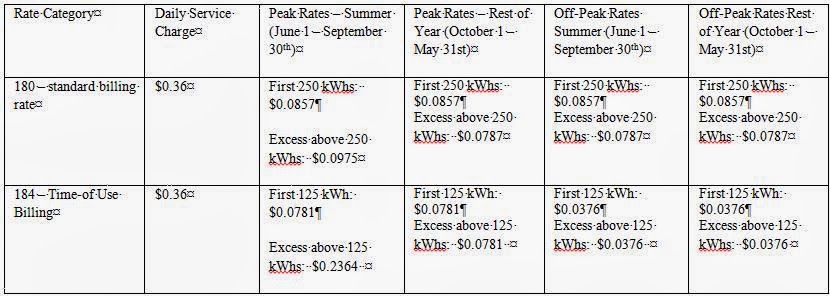
One obvious way to do this is to eliminate the 188 Time-of-Use category, leaving the 184 category as the only billing schedule for people who believe they can shift use to off-peak hours. Further, the fixed daily Service Charge should be made uniform, with everyone in the 184 category paying what 180 ratepayers now pay, $0.36 per day. Finally, the $0.10 daily meter charge imposed on 188 rate payers (but not on 184 rate payers) should be eliminated.

The 180 rates and 184 rates then would be as follows:

Applying the proposed 184 rate schedule to Fred’s actual annual usage of 23,712 kWhs, instead of paying approximately $225 more per year as a 184 Time-of-Use ratepayer than he would have under the standard rates, he would have saved $245.85. This would seem an appropriate reward for shifting his usage so that 67% of his family’s usage occurs during off-peak times. On the other hand, if Fred consumed 23,712 kWh per year, but instead of using 67% of the annual electricity during off-peak hours as his family does now, he did not shift any use (i.e., 50% used during peak and 50% during off-peak times over the course of a year), running those numbers through the proposed table produces a higher payment to LIPA than the 180 rate would have, in the amount of $180. Since the purpose of 184 is to shift electrical use to non-peak times, this result too seems appropriate. We leave it to LIPA to devise a fairer rate schedule than now exists, but it can no longer sit back and ignore the unfair results caused by its Time-of-Use rate structure.

What is the bottom line? Buyer Beware. If you switched to the 184 or 188 billing categories, thinking you were saving money while helping reduce the amount of new power sources that will have to be constructed on Long Island, you will have to do your own analysis to determine if you are paying more for the privilege of helping LIPA out. If you analyze your own bills and conclude you are paying more by being a 184 or 188 ratepayer, or even if you are unsure, you may wish to write to LIPA and demand that you be terminated from 184 or 188 billing, and ask to be put back into the standard 180 billing category. Only then will LIPA be forced to review its residential billing rates, and come up with a true system of incentives to encourage customers to shift their usage to off-peak hours.

Negotiation Trends: Salary Disclosure

Posted: September 25th, 2013

By: Joe Campolo, Esq. email

Tags: ,

Have you ever revealed how much you earn to coworkers? Your answer to that question may depend on your age.

The September issue of Harvard Law School’s Program on Negotiation newsletter discusses the trend of openness about wages between coworkers and how it may be affecting job negotiations.

Comparing salaries has long been a social taboo in the United States, but members of the millennial generation — people born in the 1980s and 1990s — are changing that, according to Kevin Hallock, director of Cornell University’s Institute for Compensation Studies.

According to a recent Wall Street Journal article, when 25-year-old Dustin Zick was preparing to leave his job with an online retailer, he compared salaries with five or six co-workers. Several of the coworkers strategized about salaries they hoped to attain and how they might negotiate for them. The discussions helped Zick meet his target salary at his next job.

Accustomed to sharing minute details of their lives on Facebook and Twitter, Millennials appear to be carrying that penchant for self-disclosure into their work lives. Websites such as Glassdoor.com, where people can post their salaries and other information about their jobs, are spurring this trend. That may be bad news for employers, who see value in encouraging employees to keep mum about their salaries.

What’s fair?

Employers have long believed that open discussion of salaries can create problems in the workplace. Knowledge of pay differences can reduce morale and productivity, researchers have found. To take just one example, the smaller the salary gap between the highest- and lowest-paid players within Major League Baseball teams, the better the team’s performance, Craig Depken of the University of North Carolina found. When we feel unfairly compensated by our organizations relative to others, we may not work as hard as we would otherwise.

Human beings have a strong desire for fairness. Yet our interpretation of what constitutes a fair salary is strongly skewed by our perspective. If you learn that a colleague who has the same job earns more than you do, you may overlook the fact that she has more experience or greater responsibilities. Our perceptions of unfairness, whether factual or not, can breed envy, discontent, and lower productivity.

Moreover, we tend to be highly driven by status concerns — that is, we care a great deal about how we measure up to others. Finding out that someone you consider to be a peer is earning more than you do could cause you to be less satisfied with your own accomplishments and also more displeased with your organization.

Negotiating in a more open workplace

If salary disclosure is, indeed, a growing trend, how can managers and employees alike engage in salary negotiations that satisfy both parties’ interest?

For employees, it’s important to move beyond your own perspective to consider possible explanations for pay discrepancies that you might have overlooked, such as whether similar-seeming colleagues have stronger credentials, greater seniority, or longer work hours. Consult others in your field, or review objective industry standards before making demands that could offend or annoy your employer. If you do find solid evidence that you are underpaid, present your employer with the facts as you see them, being careful to stress that you believe any discrepancy is unintentional.

As for employers, many rely on elaborate job grade systems that divide employees into levels with set salaries. Such clear guidelines may seem rigid, yet they can improve the odds that employees will feel fairly treated relative to others at their level.

Some employers are throwing the old rules about salary sharing out the window and striving for complete transparency. New York data analytics company SumAll, for example, reveals pay scales and individual salaries companywide. SumAll believes its employees are more efficient when they aren’t trying to guess how much others are earning, according to the Journal.