CMM | Campolo, Middleton, McCormick, LLP

Uncategorized

Starting a Successful Business

Posted: September 25th, 2015

As a self-proclaimed serial entrepreneur, I find myself immersed in the startup entrepreneurial ecosystem, specifically here on Long Island. I thrive on the process of taking an idea, helping to make it a product, and helping to build a business around it.  To have the power to take something from “all talk” to “all action” and to build wealth from it is incredibly empowering. I’d like to use this blog platform as a resource to anyone looking to take a leap into entrepreneurship and bring their business startup dreams to life. I believe anyone can make this transition.  No matter what your background, you can become an entrepreneur, and you can learn the formula to take your ideas and make them a profitable reality.

True entrepreneurs continually seek out information and advice to grow their businesses and assist them in various aspects of business management, from marketing to sales, human resources, and more. There are countless resources out there to find relevant content, one of my favorite being Entrepreneur Magazine and Entrepreneur.com, which has evolved into one of the most widely used website by entrepreneurs and leaders in business worldwide.

Carol Roth, contributor to Entrepreneur.com and entrepreneur herself, recently published a piece called, “9 Steps That Will Help Your Chances of Starting a Successful Business,” an adaption from her bestselling book, The Entrepreneur Equation. It offers some great points on preparation before you start your own business.

9 Steps That Will Help Your Chances of Starting a Successful Business

By Carol Roth

If you are unemployed, underemployed or unhappily employed, the idea of taking control and becoming your own boss might be sounding pretty sexy right about now. Plus, the past decade has shown us that jobs aren’t quite as dependable as perhaps we previously thought.

However, the success rates for new business are quite scary too, with the majority of all new businesses failing in just a few years’ time. While there is never going to be a “sure thing,” if you are thinking of leaving your job to hang out your own shingle, there are significant benefits to preparing before you take the leap.

Here are nine ways to make sure that you are prepared before you start your own business, so that you can give yourself the best chances to succeed. These are adapted from my bestselling book, The Entrepreneur Equation.

1. Define and evaluate your goals.

You can’t figure out a path to get somewhere if you don’t know where it is you want to get to. Plus, once you have that goal, you need to know if your path is the most direct route to achieving what you want.

Ask yourself tough questions about why you really want to start a business. Are you looking to get rich quick? Do you want to showcase your talent, new product idea or service? Are you tired of your boss taking credit for what you do?

These kinds of goals might lead you down the wrong path. On the other hand, if you love the idea of running an entity, if you like creating systems and procedures, adore servicing customers and if you thrive on wearing many different hats and balancing responsibilities, then entrepreneurship could be the perfect path for you.

2. Stash some cash.

The cost of starting a business in many industries has come down substantially. However, that is only part of the story. Businesses often take a few years to gain a solid foundation, so you need to have enough money to start the business, operate it while it stabilizes and also be able to live.

If you don’t have the money yourself, identify whether you have credible access to capital. The downturn has made it more difficult to secure financing and you don’t want to be three months into a business and have to decide whether to keep the business open or pay your rent or mortgage — that’s a losing proposition.

3. Get relevant experience.

Being able to manage employees and vendors is the type of skill you’ll need to acquire before starting your own business. You’ll also need to know your industry inside and out, including aspects that you may not be familiar with or even like, including marketing, accounting and more.

Don’t have the experience? Spend time working in a similar company, shadow a business owner in your industry or take a job on nights and weekends in a comparable business. Test the waters first with a trial run before you start your own company.

4. Build your network.

Business sometimes comes down to not what you know, but whom you know. If you don’t know many people or if you just haven’t warmed up your contacts in a while, now is the time to focus on building a solid network.

Strong connections can provide valuable business advice and provide introductions to get you more favorable financing, prices, terms and conditions from business suppliers and professional services. Connections are your best source of marketing and customer referrals, which is critical for a new business.

5. Know yourself.

Do you prefer the “status quo” and like to avoid the unexpected? Can you handle a life of highs and lows — including financial highs and lows? Could your savings and bank account handle financial lows as well?

If you are a person who likes stability and control, or if you prefer when things go as planned, the roller-coaster ride of a new business may not be right for you. Be honest about your personality before you take the leap.

6. Visit your lawyer.

If you are going to go into a business that competes (directly or even indirectly) with your current employer or if you plan to call on prior customers or contacts, you may find yourself in a legal bind, depending on the paperwork that you have signed with you current (or previous) employer.

Check with your lawyer to make sure that you are in the clear or to find out what you need to do to avoid any sticky legal situations.

7. Stalk the competition.

Before you leap into entrepreneurship, take a hard look at the marketplace and your competition. Is your market saturated with successful businesses? Is your industry littered with so many bad businesses that it’s developed a bad reputation?

Both good and bad competitors will influence just how successful your business will be. You will need to market and brand your business to shine above the good competitors and to make up for the bad ones.

8. Test your idea’s scalability.

The most successful businesses rely on automation and delegation. Will other employees be able to do your work? If not, can you teach others what to do in an easy-to-follow format?

If your business relies on your skills, and your skills alone, you might have a successful job, but it may not be that business opportunity you are looking for.

9. Sell first!

Too many entrepreneurs spend time and money building out retail stores, manufacturing products or developing service offerings without truly assessing the viability of the market. See if you can garner interest (in the form of purchase orders, deposits, etc.) before you invest too much capital.

If you have a lot of interest in your offering, there will be less risk in pursuing it full time. If you don’t get any bites, you may want to rejigger your offering, pricing or business model before investing your full time and effort.

Putting in the time and effort up front to stack the odds in your favor will help you avoid having one of those businesses that ends up in that percentage of failures.

http://www.entrepreneur.com/article/250252

Court Holds Successor Corporation Liable For Judgment Against Defunct Entity

Posted: September 25th, 2015

In litigation, it is one thing to obtain a judgment against an individual or entity, but it is another thing to actually collect on that judgment. One scenario that often plays out occurs when a plaintiff has obtained a judgment against a business entity only to find out that the company is out of business and/or has transferred its assets and popped up under a different name.  This strategy is undertaken for obvious reasons – to avoid collection efforts on the judgment while continuing to do business under a different identity.  However, if you are the judgment holder, all is not lost.  A recent decision from the Commercial Division in Suffolk County awarded a judgment holder with summary judgment against a successor corporation making it liable for the judgment of the defunct entity.

In All County Paving Corp. v. Darren Construction, Inc. (J. Emerson), plaintiff All County Paving Corp. (“All County”) had obtained a judgment against an entity known as Darren Construction Services, Ltd. (“Darren Construction Services”) back in 2011 in the sum of $82,275.74.  Darren Construction Services was owned by Michael Fusco (“Fusco”) who acted as the sole officer, director and shareholder of that entity. All County then commenced this action against Fusco and a different company, Darren Construction, Inc. (“Darren Construction”) alleging that Fusco created Darren Construction in an effort to avoid paying All County and other creditors.  The lawsuit alleged claims for fraudulent conveyances under the Debtor and Creditor Law and also sought personal liability against Fusco by piercing the corporate veil.  Both All County and the defendants ultimately moved for summary judgment with respect to plaintiff’s claims.

In deciding the respective motions, the Court noted that New York permits recovery of transfers when there has been a fraudulent conveyance that unfairly diminishes a debtor’s estate.  Under Debtor and Creditor Law § 273 and § 273-a, constructive fraud can be shown when the debtor transfers assets without fair consideration and the debtor is or becomes insolvent or the debtor has a judgment docketed against it that has not been satisfied.  Additionally, transfers to controlling shareholders, officers or directors of an insolvent corporation are presumed to be fraudulent and made in bad faith.  Matter of CIT Group/Commercial Servs. Inc. v. 160-09 Jamaica Ave. Ltd. Partnership, 25 A.D.3d 301, 303 (1st Dep’t 2006).  Under Debtor and Creditor Law § 276, the creditor must show actual intent to defraud on the part of the transferor in order to set aside a transfer as fraudulent.

In its examination of the facts here, the Court found that Darren Construction (the successor company) was formed August 22, 2011.  Darren Construction Services then failed to appear at a Court conference in the prior litigation a mere two weeks later on October 4, 2011 and, as a result, a default judgment was entered against Darren Construction Services on October 11, 2011.  The Court further noted that Fusco is the sole owner, shareholder and director of Darren Construction (as he was with Darren Construction Services) and the two businesses are the same, use the same phone number, and operate out of the same address.  Even more telling was the fact that, as soon as Darren Construction was formed, Darren Construction Services went out of business.  While the defendants attempted to argue that there was no transfer of assets between the two companies, the Court held otherwise, noting that the “good will” of Darren Construction Services, a saleable asset, was transferred to Darren Construction without any consideration being exchanged for such good will.  Further, at the time of the transfer, Darren Construction Services was insolvent and the judgment was unsatisfied.

As a result the Court found the transfer to be in violation of both § 273 and § 273-a of the Debtor and Creditor Law.  The Court also found that, based on the circumstances of the transfer, there was an intent to defraud in violation of § 276 of the Debtor and Creditor Law which was further confirmed by Fusco’s deposition testimony.  As such, the Court held that All County was entitled to summary judgment against Darren Construction due to the fraudulent conveyance.  As an aside, the Court denied summary judgment against both sides as it pertained to the claims against Fusco individually under a corporate veil theory noting that neither side had met its burden to warrant summary judgment.

The important takeaway from this decision is that all is not lost if you have a judgment against what appears, on its face, to be a defunct entity.  It is vital to conduct the proper due diligence even before a judgment is obtained to determine if the entity is still doing business under a different name and whether the defunct entity fraudulently transferred assets to avoid collection efforts.  It is very possible, as was the case here, that a new door will open that will allow you to collect against an entity and/or individual with assets.

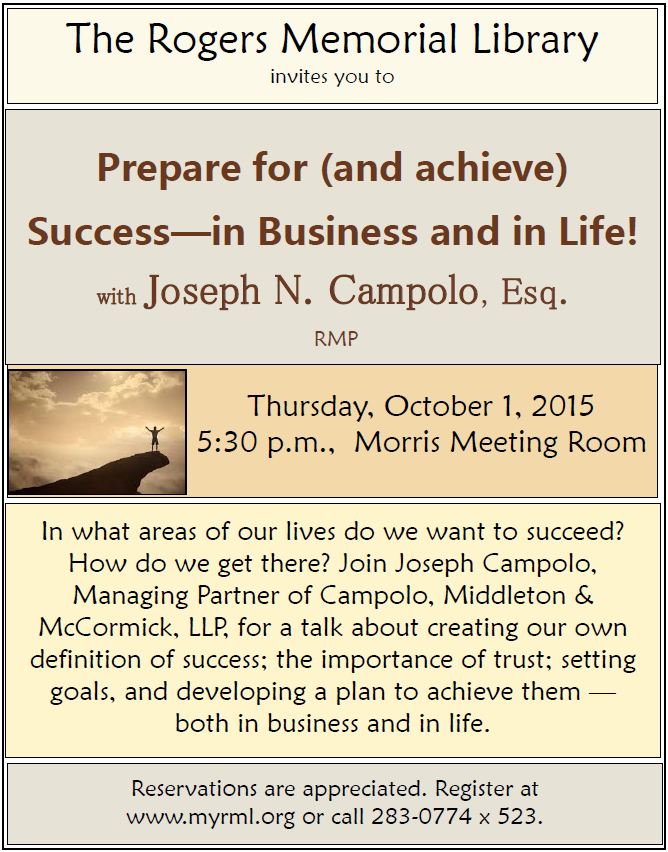
October 1: Joe Campolo presenting at the Southampton Library

Posted: September 4th, 2015

Join us on October 1st beginning at 5:30 pm at the Rogers Memorial Library in Southampton, NY. Joe will discuss how to “Prepare for (and achieve) Success — in Business and in Life!” In what areas of our lives do we want to succeed? How do we get there? Join us for a talk about creating your own definition of success; the importance of trust; setting goals, and developing a plan to achieve them – both in business and in life. Reservations are appreciated. Register at www.myrml.org or call 283-0774 x523.

JNC SH library

Shifting Credit Card Transaction Liability – The Potential Impact on Your Business

Posted: August 26th, 2015

Photo courtesy of freeimages.com. By Alex Fiore

Beginning October 1, 2015, a shift in credit card security and in-store fraud liability could place unwary merchants and business owners at risk.

EMV, which stands for Europay, MasterCard, and Visa, is a relatively new form of credit card (in the United States) that utilizes computer chip technology intended to help prevent transactional data breaches and credit card fraud.  In the U.S., most EMV credit cards contain the computer chips as well as the traditional magnetic stripe.  If a merchant does not have a payment processing system that accepts the computer chip, payments may be processed via the magnetic stripe as usual.  However, after October 1, 2015, those businesses that have not upgraded their in-store technology and processing systems to accept the computer chip portion of the card will be at risk.

Prior to the October deadline, depending on the card’s terms and conditions, the payment processor or issuer would typically be liable for consumer losses related to fraudulent transactions.  After the deadline, Visa, MasterCard, Discover, and American Express have announced that the liability for chargeback related costs of fraudulent transactions will shift to party who has not adopted the chip technology.

Generally, the EMV liability shift will have the following impact:

  • If the business has upgraded its processing systems, the issuer will continue to bear the responsibility of counterfeit or fraudulent activity.
  • If the business has not upgraded its systems and a consumer presents an EMV card, the payment will be processed via the magnetic stripe only, as it had been in the past. Here, the credit card issuer will be relieved of liability and the business will be now held responsible for consumer loss.
  • Liability for automated fuel dispensers will remain unaffected until 2017.

EMV use is already widespread in Europe.  Following suit, millions of EMV cards have already been issued to consumers in the United States, with millions more on the way.  It appears that the U.S. will eventually phase out the old magnetic stripes and smart card technology will be the wave of the foreseeable future.  Business owners may be hesitant to shoulder the costs of upgrading their current payment processing systems, but they should be aware that an upgrade now could mitigate exposure connected to EMV non-compliance in the future.

In an era of increasing consumer fraud and data theft, will your business be prepared for the EMV liability shift?

Supreme Court Preview

Posted: August 26th, 2015

Following an action-packed few weeks in June before summer break, the Supreme Court will begin its next session on October 5, 2015.  While the upcoming cases on the docket may not have generated the same attention as the major decisions reached at the end of the last term—when the Court weighed in the constitutional right to same-sex marriage and tax subsidies for the Affordable Care Act, among other headline-grabbing issues—below are summaries of cases we’ll be watching.

October 6, 2015
Ocasio v. United States
Ocasio will address a direct split among the Circuits as to extortion, specifically in the context of public officials.  Baltimore police officer Samuel Ocasio was indicted in connection with a plot to obtain payments in exchange for referrals to an auto repair shop.  The Supreme Court has previously held that a public official violates the federal Hobbs Act by obtaining “a payment to which he was not entitled, knowing that the payment was made in return for official acts.”  Officer Ocasio was convicted of conspiring to violate the Hobbs Act.  On appeal to the Fourth Circuit, he argued that he and the repair shop owners could not be guilty of conspiring to commit extortion because the shop owners were also victims of the conspiracy, and a Hobbs victim must be outside the alleged conspiracy.  The Fourth Circuit affirmed the conviction, but over in the Sixth Circuit, this argument may have prevailed.  The Supreme Court has agreed hear the question: “Does a conspiracy to commit extortion require that the conspirators agree to obtain property from someone outside the conspiracy?”

October 7, 2015
Kansas v. Gleason
A Kansas jury sentenced Sidney Gleason to death on a capital murder charge and life in prison for a variety of other charges including aggravated kidnapping, premeditated murder, and possession of a firearm.  The Kansas Supreme Court vacated the death sentence on the basis that the jury had not been properly instructed regarding how to factor mitigating circumstances into their decision.  The Supreme Court will decide whether the Eighth Amendment requires the affirmative instruction to a jury considering a death sentence that mitigating circumstances “need not be proven beyond a reasonable doubt,” as the Kansas court held, or whether the Eighth Amendment is satisfied by instructions that each juror must individually assess and weigh any mitigating circumstances.

October 13, 2015
Montgomery v. Louisiana
In 2012, the Supreme Court decided in Miller v. Alabama that mandatory sentencing “requiring that all children convicted of homicide receive lifetime incarceration without possibility of parole” violates the ban on cruel and unusual punishment under the Eighth Amendment.  Following that decision, Henry Montgomery, who has been serving a life sentence in Louisiana since 1963 for a murder committed days after his 17th birthday, asked the state court to correct his sentence.  The trial court denied his motion, as did the Louisiana Supreme Court, citing Louisiana cases holding that Miller was not retroactive.  The Supreme Court is to decide whether Miller applies retroactively to individuals sentenced as juveniles to life in prison without parole.

Sources:

www.supremecourt.gov

Kansas v. Gleason. The Oyez Project at IIT Chicago-Kent College of Law. 29 July 2015.

Ocasio v. United States. The Oyez Project at IIT Chicago-Kent College of Law. 12 August 2015.

September 29: Senator Phil Boyle Fundraiser

Posted: August 24th, 2015

boyle_lawn-sign-24x36_NYS_prtPlease join us for a cocktail party in support of Senator Phil Boyle, New York State Senator on Tuesday, September 29th from 5:30 pm – 7:30 pm at our Ronkonkoma office located at 4175 Veterans Memorial Highway, Suite 400, Ronkonkoma, NY 11779.

To RSVP contact vtringone@cmmllp.com or mtussing@gmail.com.  


September 30: CMM Exec Breakfast: Execution – the art of getting things done! – NEW LOCATION

Posted: August 22nd, 2015

cmm exec breakfast

PLEASE NOTE THE NEW LOCATION!

September 30, 2015

Execution – the art of getting things done!
Presented by Joe Campolo, Esq.

With the summer behind us and four months left in 2015, it’s time for business leaders to put in the extra effort and make the final push across the finish line.  Join us as Joe Campolo speaks to today’s business leaders, encouraging them to finish the year strong. Following up on his popular “Bleed to Succeed” presentation in which he compels Long Island professionals to set goals and develop plans to reach them, it’s now time to look at the progress you’ve made and what is left to do to complete your plan for 2015.

EVENT DETAILS:

8:30am – 9:00am
Arrival and Breakfast

9:00am – 9:45am
Presenting Speaker

9:45am – 10:00am
Q&A and Discussion

REGISTRATION: All events are FREE but registration is required. Complimentary breakfast will be served.

LOCATION: Courtyard Marriott Ronkonkoma located at 5000 Express Drive South,  Ronkonkoma,  New York  11779. Our meeting will be located in the Fire Island Conference room downstairs.

Nov 10 – Joe Campolo on HIA-LI CEO Panel

Posted: August 16th, 2015

On November 10, 2015, the HIA-LI will be hosting a executive breakfast event entitled, “A CEO’s Perspective: What it Takes to Thrive in the LI Economy.” Joe Campolo will be moderating the panel of CEO’s who are also recipients of the 2016 HIA Business Achievement Awards. Visit hia-li.org for more details.


hia ceo 11.10.15

When is a Volunteer Intern Entitled to be Paid?

Posted: July 15th, 2015

By Christine Malafi

Last year, I discussed circumstances under which a volunteer may be considered an employee for the purposes of the Fair Labor Standard Act.  As discussed previously, the Federal Fair Labor Standards Act (“FLSA”) requires both public and private entity employees to be paid minimum and overtime wages. The question of who qualifies as an “employee” under the FLSA is not as simple as you would expect. Last year, we discussed the 2014 opinion of the Second Circuit Court of Appeals, Brown v. New York City Department of Education, as to when a public volunteer may be considered to be an employee entitled to wages.

Earlier this month, in Glatt v. Fox Searchlight Pictures, Inc.,[1] the Second Circuit Court of Appeals provided some parameters as to when an intern must be a paid employee. The Court opined that the focus should be upon whom is receiving the primary benefit of the internship (the intern or the entity), and laid out seven factors to be weighed and considered in determining whether an intern must be paid as an employee:

  1. The extent to which both the intern and employer clearly understand that there is, or is not, an expectation of compensation (any promise of compensation, express or implied, suggests that the intern is entitled to wages);
  2. The extent to which the internship provides training that would be similar to that which would be given in an educational environment, including clinical and other hands-on training;
  3. The extent to which the internship is tied to the intern’s formal educational program by integrated coursework or the receipt of academic credit;
  4. The extent to which the internship accommodates the intern’s academic commitments (i.e, following the academic calendar);
  5. The extent to which the duration of the internship is limited to the period in which the intern will receive beneficial learning experiences;
  6. The extent to which the intern’s work compliments, rather than displaces, the work of paid employees, while providing significant educational benefits to the intern; and
  7. The extent to which both the intern and the employer understand that there is no entitlement to a paid job at the conclusion of the internship.

No one factor is primary to determining whether the intern must be paid under the law for his or her work. Every factor need not point in the same direction, and the courts may consider other relevant evidence (beyond the above seven factors) in determining who is the primary beneficiary of the relationship, and hence, whether wages to the intern are required.

The decision in Glatt serves as an important victory for employers, as private employers now have been given parameters under which to determine whether an intern must be paid under the FLSA.

[1] Nos. 13-4478-cv, 13-4481-cv (July 2, 2015).

McCormick quoted in LIBN article “Lawyers Are Taking to Tech”

Posted: July 13th, 2015

Lawyers are taking to techBy Joe Kellard, Long Island Business News

When discussing one of the most popular programs attorneys attend for continuing legal education, Mary Ann Aiello, dean of the Nassau Academy of Law, painted an image of a seasoned lawyer in court shuffling through hundreds of legal papers, while his younger counterpart pulls up the same documents with a quick search on his laptop or iPad.

Of the 160 programs the academy provides for attorneys to acquire the New York State-mandated credits they must earn every two years, courses on technology and social media have become the rage. While the academy, an arm of the Nassau County Bar Association, has noticed a need for more skill-based and practice management programs, Aiello said, increasingly more lawyers are asking for and attending tech and social media programs related to all areas of their profession, from criminal cases to electronic discovery to online office policies.

“A lot of attorneys feel that they don’t have the updated electronic skills that many young people have,” said Aiello, an attorney who organizes programs for the academy.

Even recent law school graduates are taking these programs, if only to keep up with the latest developments and their applications to law, Aiello said.

Patrick McCormick, a partner at Campolo, Middleton & McCormick in Ronkonkoma and an officer and CLE lecturer at the Suffolk Academy of Law – the educational branch of the Suffolk County Bar Association – also finds that a diverse cross-section of lawyers are taking many technology and social media programs. These technologies impact every facet of law, he said, from lawyers selecting juries to juries on break using Google to investigate the case.

“It used to be if we had a law suit, I would ask the other side to give me all the paperwork you have on it, and he’d ask the same of me and we’d move on,” said McCormick, who has practiced law for 28 years. “Now you have privacy issues: what to do with a person’s cell phone and text messages and the posts they put on Twitter and Instagram, and that area of law is developing almost every day. So there’s a need for it and lawyers are asking for it.”

Before they retain a client, more lawyers are asking what on their social network pages may come back to undercut or destroy their case. Aiello recalled a case when she was retained to represent a woman whose under-aged niece claimed she pushed her down a flight of stairs. Within a day of her fall, the girl took to social media and made accusations.

“The girl who made the accusation posted on her Facebook account: ‘I’ll show my aunt, that (expletive.) I told the police she pushed me down the stairs even though she was nowhere near me when I fell,’” Aiello recalled. “So attorneys have to be aware of and advise their clients of this, because, we’re really living in a fish bowl now.”

The state deems it essential that attorneys earn CLE credits to continue to practice law, to gain the necessary knowledge and skills to competently represent their clients and to comply with the New York State rules of professional conduct. While state rules do not mandate that attorneys have any level of technological knowledge, the New York State Bar Association declared in its recently revised guidelines that knowledge of how social media works should be a core skill for a state attorney.

“A lawyer cannot be competent absent a working knowledge of the benefits and risks associated with the use of social media,” the instructional guideline states.
Newly admitted attorneys are generally required to take at least 16 credits in each of the first two years of practice, after which they are mandated to take a minimum of 24 credits every two-year cycle. At least four credits must pertain to law and professionalism.

Omid Zareh, a chair of the Nassau County Bar Association’s ethics committee, recently presented a CLE program entitled “Avoiding Ethical Problems in the Internet Age,” which he said was well attended and sparked a lively, spirited discussion on acting ethically online.

“There’s been a tremendous amount of interest for these types of things,” said Zareh, who suggested the ubiquitous uses of smart phones are primarily driving this trend.

Among the issues raised at CLE programs that Zareh has hosted pertain to the appropriate professional use of Facebook and Twitter and representing oneself as a specialist, when there are specific guidelines about this.

“If you’re saying you’re a specialist without actually having gotten a specialty from a recognized entity, then you’re really just saying: I think I’m a specialist and I’m just going to tell you I am,” he said.

Another hot topic is third-party endorsements on LinkedIn, the professional networking site, and whether attorneys should leave or take down those that don’t pertain to what they do. The state bar’s other new or expanded guidelines posit that attorneys should take responsibility for the accuracy of third-party endorsements posted on their social networking profiles and to correct misleading or inaccurate information.

“A lawyer may not passively allow misleading endorsements as to her skills and expertise to remain on a profile that she controls, as that is tantamount to accepting the endorsement,” the report reads.

http://libn.com/2015/07/06/lawyers-are-taking-to-tech/